
Eugene Peterson (1932-2018) was an influential writer and theologian. But at heart, he was first a pastor. He wrote more than 30 books, including The Message (a paraphrase of the Bible) and A Long Obedience in the Same Direction. As I reflect on people who have influenced me, Peterson—though I never met him—stands tall.
He was raised by hard-working parents in the rugged hills of Montana. His father ran a butcher shop while his mother held religious meetings in small out-of-the-way settlements of miners and lumberjacks scattered around their valley in the Northern Rocky Mountains. Peterson writes, “I can’t imagine now not being a pastor. I was a pastor long before I knew I was a pastor; I just never had a name for it.” He described the calling coming to him “like a glove that fit his hand perfectly.”

Peterson reflects on how his father’s butcher shop was his introduction to the world of congregation. He writes that the people who came into the shop weren’t just customers: “Something else defined them. It always seemed more like a congregation than a store. My father in his priestly robe (his white butcher’s apron) greeted each person by name and knew many of their stories.” (The Pastor, p. 39)
In a different way, I saw something similar growing up. My grandparents, Robert and Lena Lee, ran a hardware store in King of Prussia, a suburb of Philadelphia. They first opened the store in 1957. It was long before the big-box stores came marching in. The original store was along Route 202—within an eye’s sight of what is now one of the largest shopping malls in the country. Later, they relocated the store to an old farmhouse where the buildings had been turned into local stores—including a pharmacy and Vito’s Pizza among others. My grandparents knew their customers by name. In fact, my grandfather kept detailed notes on their purchases, down to the size of their furnace filter. When someone needed a filter, he knew exactly what size. In a way, the hardware store was like a congregation.
Somewhere along the way, we’ve drifted from truly knowing one another. Whether it’s a favorite cut of meat or scooping a bag of 16-penny nails, how can we as a congregation get back to being present to one another in good times and in bad?
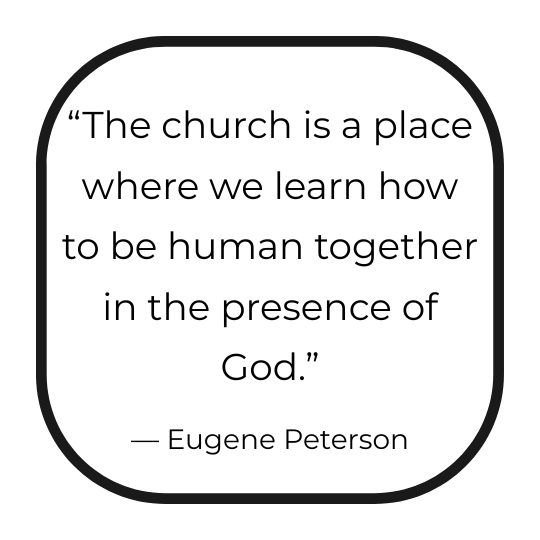
At its best, a congregation is not a place where people are processed—it’s a place where people are known. Maybe we would do well to reclaim Peterson’s vision of congregation:
I am quite sure now that the way I, as a pastor, came to understand the congregation had its beginnings in the “congregational” atmosphere of our butcher shop. Congregation is composed of people, who, upon entering a church, leave behind what people on the street name or call them. A church can never be reduced to a place where goods and services are exchanged. It must never be a place where a person is labeled. It can never be a place where gossip is perpetuated. Before anything else, it is a place where a person is named and greeted, whether implicitly or explicitly, in Jesus’ name. A place where dignity is conferred. I first learned that under my father’s priesthood in his butcher shop. (The Pastor, p. 40)
Will you join me in asking some tough questions about our church?
- How are we doing as a congregation? What do guests see, hear, smell, and feel when they first arrive?
- What messages are we communicating, spoken or silent, intentional or unintentional?
- Who are we reaching? Who is not here? Why?
- If our church ceased to exist tomorrow, would we be missed? Why?
In summary, how can we be better at congregation? There has never been a more important time to wrestle with this question. I’d love to hear your thoughts—give me a call, or perhaps we can chat over coffee.
In Christ’s care,
0 Comments