While in college, American Literature was one of the course requirements for the Bachelor of Arts degree (my major was Political Science). The professor required us to read and analyze books from various time periods. One of the books on the list was Walden by Henry David Thoreau (1817-1862). The title came from the author’s experience of living for over two years in a small cabin he built in the woods at Walden Pond, just outside of Concord, Massachusetts. One of the ways I remember analyzing the book for class was relative to its title, Walden. I interpreted that it could be a metaphor for being “walled in” or isolated from the surrounding community. In reflecting on this some 35-plus years later, how might this bear a message to the church of today? Keep reading to see how . . .
Just as Thoreau physically withdrew to Walden Pond to find deeper meaning in life and to connect with nature, churches can become “walled in” and internally focused rather than reaching out with a spirit of invitation. This is a challenge for us all. Whenever new people become part of any organization, including churches, they bring their own past experiences, hurts and hopes for the future. Sometimes, those who have been around for a while can become anxious and feel like they are losing control. The tendency is to “circle the wagons” and become inwardly focused and protective. Often, this is an emotional response which can hinder growth. We are reminded of our apostolic call to be on mission with God, where Jesus said, “Peace be with you! As the Father has sent me, I am sending you.” (John 20:21) He also said, “Therefore go and make disciples of all nations.” (Matthew 28:19a)
So how do we balance a spirit of invitation to others while strengthening the fellowship of those who are already here? Maybe the following illustration on the Polegreen church will help (it’s from a sermon I preached here on May 15, 2016):
In the early history of Virginia, the colony was Anglican. The State and the Church were mostly one. The government sanctioned the church, built churches, and paid for the clergy salaries and housing through taxation of the citizens.
When the First Great Awakening swept across the colonies in the 1730s and 1740s, people known as dissenters started to gather in “reading houses.” They were not “churches” but rather homes where dissenters from the Anglican Church came to read the Bible and discuss what they read. Preachers who were influenced by the Great Awakening were invited to these reading houses to preach. There were three such reading houses in Hanover County and one in Henrico. The governor had licensed them which allowed the dissenters to gather and read the Bible. One of the houses in Hanover was named the Polegreen reading house. This is where Samuel Davies, a young Presbyterian from Pennsylvania, was invited to come and was the first non-Anglican minister licensed to preach in Virginia.
People came from all over to hear Davies preach. Included in the congregation was a young boy from Studley whose mother took him to hear Davies. He credits the Rev. Davies with “teaching me what an orator should be.” His name was Patrick Henry, one of our founding fathers and the first governor of Virginia. Henry was instrumental in the movement for religious freedom in Virginia and America. (Religious freedom is one of the historical distinctives of Baptists.)
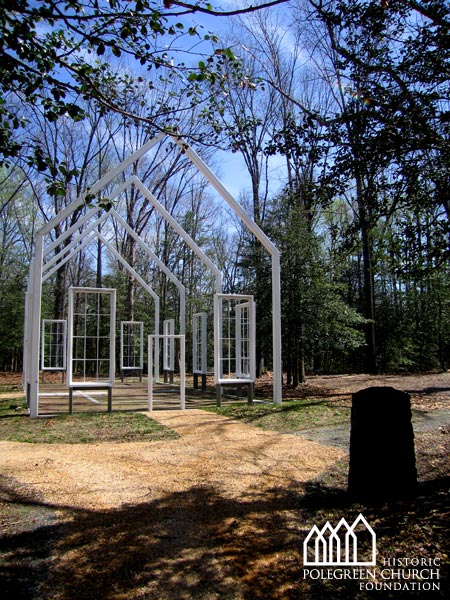
Davies led the people to construct a church building. During the American Civil War, the Union army occupied the Polegreen church. Confederates fired upon it to force the out Union. Sadly, the church burned. The Polegreen church was never reconstructed after the war. But in [recent years], an effort has been made to reclaim the site as a significant historical landmark. Preservationists have constructed the framing of the church where the original building once stood (photo right). It gives people an idea of the size and scope of the church. But could this mean more to us today?
Perhaps this historical marker is more than a historical relic. What if it is a vision for the modern church and its outreach to the community? There is something very unique about the shell of the original Polegreen church: there is no ceiling; there are no walls; there is no door. A church that is like an open window where members and outsiders can connect with no barriers. A church that is not “walled in.”
As we celebrate HRBC’s 60th birthday on Heritage Day this coming Sunday, may we learn from our past, celebrate the present and envision a future with nolimitations. May we rise up to the challenges that lie ahead, trusting in our God with whom, “all things are possible.” (Matthew 19:26)
Congratulations to HRBC on their 60th anniversary!!! Mat God continue to richly bless His people as they serve the community of Richmond and beyond!!! Linda and I will never forget the warm and loving church we attended for over 15 years. We miss you, and are grateful for all the friends and fellowship. All our love. Mike and Linda Mueller

Congratulations to HRBC on their 60th anniversary!!! Mat God continue to richly bless His people as they serve the community of Richmond and beyond!!! Linda and I will never forget the warm and loving church we attended for over 15 years. We miss you, and are grateful for all the friends and fellowship. All our love. Mike and Linda Mueller
Thank you Mike! May God bless you and we wish y’all well! Blessings, Pastor Bob