
Have you ever wondered how a seed becomes a plant? Better yet, have you ever wondered how a seed knows what type of plant to become? This mystery is wrapped up in the way God established the earth, with intricate design coupled with purpose and intentionality. We hear this same purpose from Jesus as he used the image of seeds to teach his followers about resurrection: He said, “Very truly I tell you, unless a kernel of wheat falls to the ground and dies, it remains only a single seed. But if it dies, it produces many seeds.” (John 12:24) Perhaps a trip back to science class will help us to reflect on what Jesus said . . .
What does it mean for a seed to die? Are we to suppose that the seed is just absorbed into the ground – that’s it? End of seed? Nothing more? I don’t think so. If we study how seeds produce plants, then we quickly see that the seed’s death is actually a transformation from seed to plant, which in turn yields more seeds. The circle of life continues!
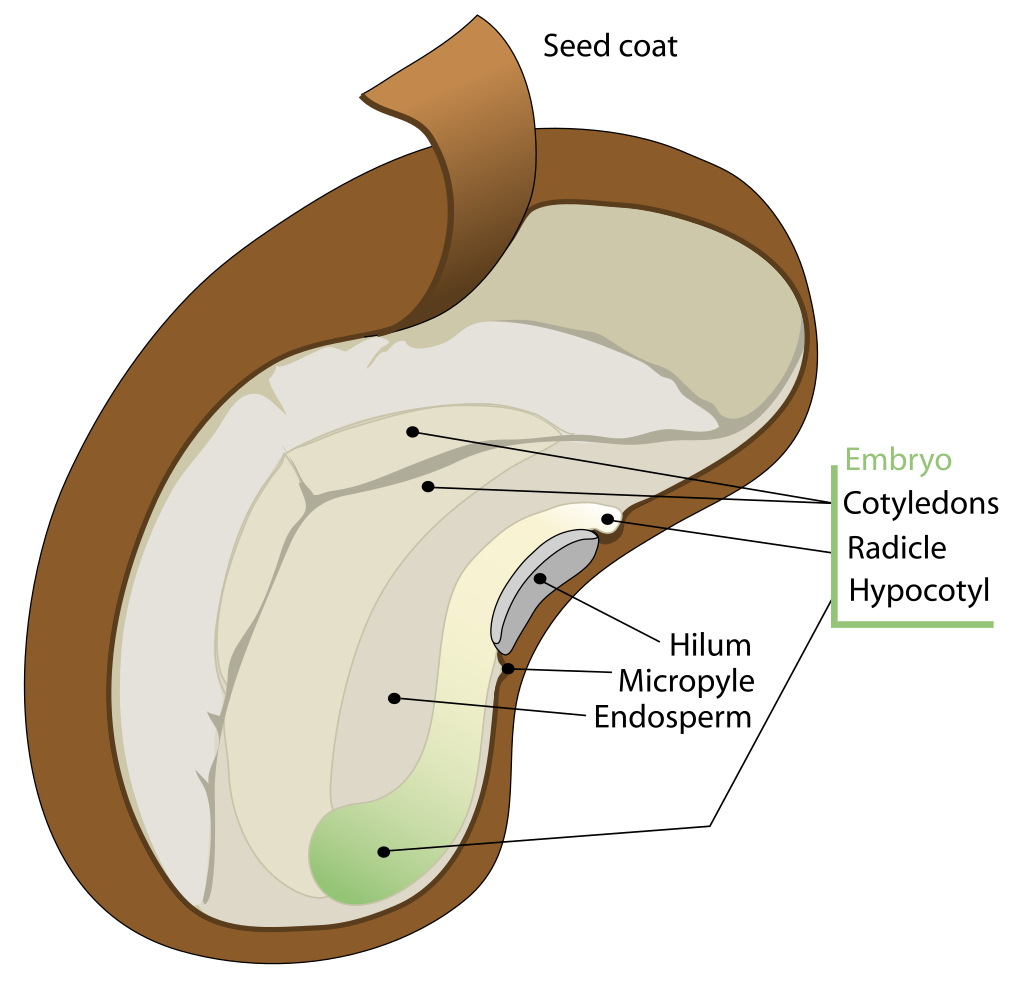
Do you remember fifth-grade science when most of us learned about the anatomy of a seed? — (see above image – source Wikipedia, public domain). The seed has an outer coat which protects the embryo and its three parts: radicle, which develops the root system; hypocotyl, which enables the seed to emerge from the soil; and cotyledons, which are seed leaves that give the embryo nutrients.
Now, let’s address the idea of the seed “dying” so the new plant can emerge. When we say the seed “dies,” we are referring to the irreversible changes that occur during germination. The seed coat, which protects the embryo, softens and often splits open to allow the emerging radicle and cotyledons to emerge. Additionally, the stored nutrients within the seed are depleted as they are used to fuel the initial stages of growth.
In a sense, the seed undergoes a transformation from a dormant, inactive state to an active, growing state! This transformation involves the breakdown and consumption of its own resources, which can be likened to a form of “death” in the context of the seed’s life cycle. However, it’s important to note that this “death” is not the end but rather the beginning of new life as the plant emerges and begins its journey towards maturity.
Now we can start to understand how this metaphor brings light to Easter. Jesus died and was buried on Good Friday. Paul writes that God raised him to life on the third day (1 Cor. 15:3-4). Later, in the same chapter, Paul continues: “What you sow does not come to life unless it dies. 37 When you sow, you do not plant the body that will be, but just a seed, perhaps of wheat or of something else. 38 But God gives it a body as he has determined, and to each kind of seed he gives its own body.” (1 Cor. 15:36-38)
Easter reminds us that because of the resurrection of Jesus, we, too, are raised to new life. But this new life involves a “death of the old self.” We are changed and transformed, and God enables us to produce new seed that will bring kingdom growth. Jesus said, “25 Anyone who loves their life will lose it, while anyone who hates their life in this world will keep it for eternal life. 26 Whoever serves me must follow me; and where I am, my servant also will be. My Father will honor the one who serves me.” (John 12:25-26)
This Easter season, may we reflect upon the mystery of the seed and the profound truths it reveals about the nature of our faith. May we find inspiration in the promise of new beginnings, even amidst the darkest moments of our lives, trusting in the transformative power of God to bring forth beauty from ashes and life from death. As we behold the empty tomb and proclaim, “He is risen,” may we rejoice in the assurance that death has been conquered, and that through Christ, we too can experience resurrection and the promise of abundant life on earth and throughout all eternity!
With God’s abundant love and amazing grace,
0 Comments